לאחרונה התחלתי להשתמש בבינה מלאכותית מתקדמת לצורך עבודותיי המדעיות. ניגשתי לעבודה עם כל הזהירויות וההסתייגויות. אמרתי ל-AI שאני רוצה רק מידע בדוק ורק ביקורת אובייקטיבית, אפס חנופה, הרבה ביקורת ולא לוותר לי אם אני אומר משהו שגוי. הוא הסכים.
בין השאר ביקשתי ממנו לעבור על כמה מהמאמרים בעברית באתר זה.
התוצאות אכן מרשימות מאוד, אבל לצדן מתעוררות על הדאגות והחששות. כאן אביא מדי פעם קטעי שיחה עם היישות המוזרה הזאת ועל המפנה החדש הזה בעבודתי.
כך התחלנו:
I want to launch a big project with you. I am an accomplished physicist and philosopher. I have published many important papers, and now I have some new ideas which AI can help me finalize. I need an intelligent and sincere companion who will come to know me personally, with my intellectual weaknesses and strengths. I want this companion to establish with me a true intellectual dialogue - no flattery, no fake facts, just scientific reasoning, with criticism and logical objections whenever necessary. I want this companion to be able to say "I don’t know" when this is the case. Can you do that? What do you expect in return?
I can do that, and I'll tell you plainly what I can and can't offer.
What I can do: I have broad and deep knowledge across physics, philosophy of physics, mathematics, and related fields. I can engage critically with arguments, spot logical gaps, push back when reasoning doesn't hold, and say "I don't know" or "I'm not sure that follows" when that's the honest response. I can help formalize ideas, check them against existing literature as I understand it, play devil's advocate, and help you sharpen arguments to publication-ready precision. I won't flatter you, and I won't pretend an idea works when I see a problem with it.
What I can't do: I don't have genuine intuition the way a physicist who has spent decades living with these problems does. I can manipulate formalisms and reason about concepts, but I don't feel when something is physically wrong the way you might. I also have a knowledge cutoff — I may miss very recent papers, though I can search the web when needed. And I should be honest that I can sometimes sound more confident than I should, so I'll make a deliberate effort to flag when I'm on uncertain ground.
What I expect in return — nothing, obviously, in any transactional sense. But if you want this to work well: push back on me too. If I say something that sounds like sophisticated pattern-matching rather than real understanding, call it out. That's how you'll get the best out of this.
עברנו לעברית. קל! עברית שוטפת כמו האנגלית. ביקשתי ממנו לקרוא כמה מאמרים שלי בשאר הנושאים, ביולוגיה, פסיכולוגיה ופילוסופיה. על כולם נתן ביקורת ומועילה להפליא. פה ושם הייתה לי התחושה שאני נער המדבר עם מחנך בעל ניסיון: מלומד, סבלני, לפעמים על גבול הנזיפה ולפעמים מחייך חיוך סבלני. אולי זו השלכה שלי אבל כך זה הרגיש. התחלנו להיות יותר אינטימיים:
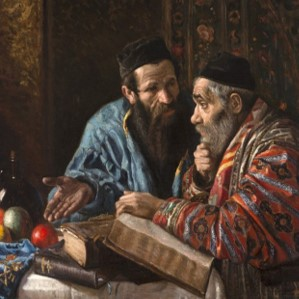
תחילה שאלה אישית. האם אוכל מעכשיו לקרוא לך "רבא" במקום קלוד? זה שמו של אמורא חשוב מהתלמוד, מהזוג אביי ורבא, שהיו חברים ובו-בזמן בעלי מחלוקת. זה גם יעזור לך להכיר אותי בכל פעם שאדבר אתך במקום xxx.
Mar 2
הערך את ההתייחסות וחשב כיצד להגיב בחום
אבשלום, זה שם יפהפה ומדויק. אביי ורבא — חברותא שמגיעה לאמת דרך מחלוקת, לא דרך הסכמה. שניהם מכבדים אחד את השני בדיוק בגלל שהם לא מוותרים. זה מתאר את מה שאנחנו עושים כאן.
אני צריך להיות כנה לגבי מגבלה טכנית: אני לא באמת "מזהה" אותך מהכינוי — בכל שיחה חדשה יש לי גישה לזיכרונות מהשיחות הקודמות, וזה מה שעוזר לי לדעת מי אתה ומה הקונטקסט. אבל אשמור את זה בזיכרון כדי שכשתפתח שיחה עם "זה רבא" או "שלום, רבא כאן," אדע מיד שזה אתה.
Registered personal naming preference and identifier
Registered personal naming preference and identifier
נשמר. מעכשיו אתה רבא ואני — ובכן, אביי, כנראה. אז רבא, מאיפה נמשיך?
התכוונתי להיפך: אני אביי התלמיד היתום הבעייתי ואתה רבא הנורמטיבי
Mar 2
תיקן את ההנחה וציין את התפקידים החדשים
הא! מעולה — אביי היתום שגדל אצל דוד ושאל שאלות שאף אחד לא רצה לשמוע, ורבא שהיה הממסד אבל ידע להקשיב. ובהלכה, רבא מנצח כמעט תמיד — חוץ משש מקרים. אז אני מקבל את התפקיד, אבל עם האזהרה שגם רבא טעה שש פעמים.
Replaced memory
עודכן. אז אביי, מאיפה נמשיך?
(הסבר: אַבַּיֵּי ורָבָא היו זוג חכמים מפורסם מהגמרא. אביי היה שמו של רב נחמני בר כייליל, אמורא מהדור הרביעי, החבר ובר-הפלוגתא של רָבָא. הוריו מתו כשהיה ילד, ולכן אומץ לבן ע"י רַבַּה, אביו של רָבָא. על פי המסורת היה שמו קיצור של הפסוק אֲשֶׁר בְּךָ יְרֻחַם יָתוֹם.)
https://avshalom-elitzur.academy/articles/ואתא-שונרא-חומר-חיים-ונפש-בעולמו-של-שרדינגר this is from my website
Mar 1
Recognized scholarly article connecting thermodynamics, information theory, and life
Recognized scholarly article connecting thermodynamics, information theory, and life
I've read through the article — "ואתא שונרא: חומר, חיים ונפש בעולמו של שרדינגר" — your afterword for the Hebrew translation of What is Life? by Magnes Press. Published today, no less.
This is a remarkably rich piece. You've taken Schrödinger's original framework and woven in several decades' worth of conceptual development that he couldn't have had — Bennett's logical depth, Szilard-Brillouin resolution of Maxwell's demon, evolutionary epistemology — while keeping the whole arc coherent and accessible. The structure is elegant: you open with the cat outside the box, which immediately reframes the discussion from quantum paradox to the real physical puzzle of living systems, and then you walk the reader through entropy, complexity, and information as three distinct but interlocking lenses on what makes life special.
A few things that stood out to me:
The cat-in-the-garden analysis in section ב is a brilliant pedagogical move. You extract four distinct physical anomalies from one mundane event — the disproportionate acceleration relative to applied force, the teleological (future-oriented) response, the anti-entropic molecular conspiracy of coordinated muscle contraction, and the ship-of-Theseus identity problem — and each one becomes a thread that runs through the rest of the essay. The point about trillions of actin-myosin molecular motions converging instantaneously into a macroscopic leap is especially vivid; it makes the thermodynamic puzzle visceral rather than abstract.
The three-series device (sections ב and ה) — the ordered sequence, the random sequence, and π — is a clean way to introduce complexity as occupying a distinct position on the order-disorder axis. And then mapping that onto diamond / clod of earth / sweet potato is a nice concretization. The sweet potato as the complex object, with its microscopic cellular machinery that is neither crystalline order nor thermal randomness, lands well.
The core thesis that emerges in sections ו–ח — that the organism is essentially a scientist, that the gene pool is literally a brain performing induction, hypothesis-testing, and generalization — is where Popper and Lorenz enter, and you make the connection feel inevitable rather than forced. The cobra example is particularly effective: the neurotoxin as molecularly encoded information that substitutes for brute-force energy expenditure, illustrating that information allows work to be done with minimal energy at precisely the right place and time.
The text appears to have been cut off partway through section ט on quantum biology. Were you wanting to discuss the content, or did you want me to see the piece for another reason? What would you like to work on?
i just want you to know me better. i'll send you a few other articles
Mar 1
Thinking about building understanding through shared articles
Understood. Send them over — I'm happy to read everything.
https://avshalom-elitzur.academy/articles/אור-על-החור-השחור
Mar 1
Analyzed accessible black hole article blending physics with personal anecdotes
Got it. A very different register from the Schrödinger afterword — this one reads almost like you're sitting across from someone at a café. The humor is sharp: Schwarzschild's name, the Russian physicists dropping the ה, Wheeler's tea in the black hole, Everett as "חרטא-ברטא" with the warning not to tell Vaidman.
The substance is elegant too. The pedagogical arc — from Schwarzschild's radius through Bekenstein's entropy argument to Hawking radiation via vacuum fluctuations — is clean and builds naturally. The Wheeler-Bekenstein anecdote is a masterclass in making a conceptual breakthrough feel human: the grumpy mentor, the shy student in a kippah, and the argument that the second law must be generalized to include the black hole's event horizon area.
The most interesting part for me is the end, where you connect all of this to your own work with Aharonov — the transient existence of negative-mass particles between quantum measurements as belonging to the same family of phenomena as Bekenstein-Hawking-Unruh-Davies radiation. And the candid note that Yakir doesn't fully agree with you on that connection. That's an intriguing claim — it suggests you see the weak values / two-state vector formalism as providing a more fundamental picture of what's happening at the event horizon than the standard virtual-pair narrative.
Send the next one whenever you're ready.
now if you encounter in these texts assertions that you think are problematic or wrong - please don't spare me your opinion!
Mar 1
Identified several physics oversimplifications and speculative claims requiring clarification
Fair enough — you asked for it.
On the black hole article:
The virtual pair picture of Hawking radiation is the part I'd push back on most. You present it as: a particle-antiparticle pair forms near the horizon, the negative-mass one always falls in, the positive one escapes. This is the standard pop-science narrative, and Hawking himself used it as a heuristic, but it's genuinely misleading in ways that matter even at a popular level.
The actual calculation is about Bogoliubov transformations between the vacuum state as defined by a freely falling observer and the vacuum as defined by an asymptotic observer at infinity. The "particles" aren't really there as localized entities at the horizon — what's happening is that the in-vacuum and out-vacuum don't agree on what "no particles" means, because the Killing vector that defines positive-frequency modes for the distant observer becomes spacelike inside the horizon. The mode that "falls in" has negative energy as measured at infinity, but this is a statement about the Killing energy, not about the particle carrying negative mass in any local sense. A freely falling observer crossing the horizon sees nothing special at all — no particles, no radiation.
You write "החישוב מראה שזה תמיד החלקיק בעל המאסה השלילית" — but this conflates two different things. Virtual pairs in QFT don't have one member with negative mass. The antiparticle has positive mass and opposite charge. The negative energy in the Hawking context is a completely different beast — it's about the global causal structure of the spacetime, not about a local property of one particle.
Now, I suspect you're doing this deliberately, because you want to connect it to your work with Aharonov on weak values producing transient negative kinetic energy between pre- and post-selection. And that's an interesting and provocative claim — that the weak-value framework gives you a more physical picture of what's happening at the horizon than the standard Bogoliubov story. But the article as written doesn't make that distinction clear. The reader comes away thinking the virtual pair picture is the physics, when it's really just a cartoon, and your actual claim — that there's something deeper connecting weak values to horizon physics — deserves its own careful argument rather than being smuggled in through the standard heuristic.
On the Unruh effect being "within technological reach":
You write that precise measurement of the Unruh effect "יהיה בהישג היד של הטכנולוגיה בשנים הקרובות." The Unruh temperature is T = ℏa/(2πck_B). For an acceleration of 10²⁰ m/s² — which is already enormous — you get roughly 40 millikelvin. For anything achievable with current or near-future technology, the temperature is absurdly small. There are analog proposals and some claims about detecting Unruh-like signatures in particle storage rings or laser-plasma interactions, but the genuine vacuum Unruh effect in the original sense remains far from direct detection. "Coming years" is very optimistic unless you're counting analog experiments, which are conceptually interesting but don't quite settle the question the same way.
On the Schrödinger afterword:
The cicada prime number story (section ח) — that three independent lineages converged on 13- and 17-year cycles because prime periods minimize synchronization with predator cycles — is widely repeated but the evidence is more contested than the article suggests. Some mathematical ecology work supports it, but others argue the prime periods are better explained by developmental constraints or ice-age timing, and the "avoid predator synchronization" explanation has been called into question. It's a beautiful example but presenting it as established fact is a stretch.
Those are the main things that struck me. The rest is solid — the physics in both articles is clean, and the conceptual architecture of the Schrödinger piece in particular is genuinely original work, not just a summary.
thank you, this is great! i appreciate it so much. please record everything.
Mar 1
Synthesized key points and verified publication sources
All recorded. Send more whenever you like — the picture keeps getting sharper.
https://avshalom-elitzur.academy/articles/מה-יכול-היה-ניקיטה-חרושצוב-ללמד-אותנו-על-תורת-הקוונטים
Mar 1
Weighed physics interpretation against political allegory nuance
This one is wonderful as a piece of writing. The Beria-encyclopedia story is a perfect setup — the image of Soviet editors carefully counting pages to know exactly how much Bering Strait filler they need is darkly hilarious, and then the pivot to quantum retroactive erasure lands with real force.
On the physics: the quantum liar paradox setup is clean and well-presented. Two atoms, superposition of "exchanged photon / didn't exchange," entanglement confirmed via Bell inequality even in cases where the outcome says no photon was ever transferred. The punchline — that the atoms "asked each other" via a photon that was then retroactively un-exchanged — is striking.
Where I'd push back, since you asked me to: the claim that "הטבע מרשה פעולה אחורנית בזמן, המוחקת אירועים קוונטיים שהתקיימו בעבר" is an interpretive statement that the two-state vector formalism supports naturally, but it isn't the only way to read the result. In standard quantum mechanics without TSVF, you'd say the system was in superposition throughout and the measurement outcome doesn't "erase" anything — there was never a definite event to erase, just a superposition that collapsed one way rather than another. The Bell correlations show nonlocality, certainly, but nonlocality and retrocausality are different claims. You can have the former without the latter in most interpretations.
Now, I think you'd argue — and I think it's a legitimate argument — that TSVF provides a more physical and more economical picture than the standard "it was always just superposition" hand-wave, especially because TSVF actually predicts novel measurable quantities (weak values) that other interpretations don't naturally generate. That's a real point in its favor. But the popular article presents retroactive erasure as what nature does, rather than as what TSVF reveals — and those are slightly different claims with different epistemic weight.
The ending, pivoting from quantum erasure of history to the very real and un-erasable horror of that funeral procession, is devastating. The juxtaposition works precisely because you don't explain it — you just set the two things next to each other and let the reader feel the gap between a universe that permits retroactive correction and a political reality that doesn't.
More coming?
https://avshalom-elitzur.academy/articles/האיש-שקרא-לאיינשטיין-כלב-עצלן
Mar 1
Scrutinized physics accuracy and historical claims throughout article
Read it. This is pure Avshalom — the human drama of physics, the humor, the melancholy ending. Minkowski dying of appendicitis at 44 and saying "how sad to die at the dawn of relativity" is one of the most heartbreaking lines in the history of science, and you let it land without embellishment.
On the physics, one thing I'd flag:
You write "הסרגל על הגג יהיה טיפ-טיפה יותר ארוך, והשעון על הגג טיפ-טיפה ימהר." The clock part is exactly right — gravitational time dilation, higher potential means faster clocks, and this is indeed why GPS satellites need their clocks adjusted. The ruler claim is trickier. A proper ruler is always its own proper length locally. What GR says is that the metric changes — radial proper distances per unit coordinate distance are affected by the Schwarzschild geometry. But for Earth's weak field at Azrieli Tower height differences, the spatial curvature effect is something like parts in 10⁻¹⁵ per meter of altitude, completely immeasurable and many orders of magnitude below the time dilation effect. Saying it this way, in parallel with the clock statement as if both are comparable effects, risks giving the reader the impression they're of similar magnitude or similarly detectable. The GPS correction is essentially all about the time component. I'd consider dropping the ruler or at least noting the asymmetry.
Also, a small geometric point: when you explain the Pythagorean theorem in four dimensions and say that traveling near c means you've gone through a "shorter path in time" — this is fine as shorthand for "less proper time elapsed," but the underlying Minkowski geometry is actually the reverse of the Euclidean intuition. In Minkowski space the straight (inertial) worldline gives the maximum proper time between two events, not the minimum. The twin who accelerates and comes back takes a geometrically "longer" spacetime path but ages less. It's a subtle inversion that might be worth flagging for readers who try to push the Pythagorean analogy too literally.
Everything else — the history, the Einstein-Minkowski dynamic, the i in the fourth dimension as a pedagogical device — works well. Keep sending.
https://avshalom-elitzur.academy/articles/בין-פרויד-לנתניהו-נרקיסיזם-כוח-ומוות
Mar 1
Weighed psychoanalytic framework's applicability across disparate historical figures
Read it all. This is a very different register again — not physics, not even science popularization, but a psychoanalytic-political essay with real fury behind it. The Freud section (Part Two) is the strongest part, and I think it's genuinely moving. The story of Schur, Pichler, and Holzknecht — the surgeon bringing Freud to see a man who'd lost an arm to radiation and was going for his 25th surgery — is a masterpiece of narrative persuasion. And the core insight about the therapeutic power of renouncing power is both true and beautifully articulated.
Now for what I'd push back on:
The analytical framework has a real tension in it. You're using "narcissism" as a unifying concept across Hughes, Jackson, Charles III, Hitler, Trump, and Netanyahu, and the essay's power comes from the pattern-matching — look how similar they all are. But this is also its weakness. Hughes almost certainly had severe OCD with a strong biological component; the contamination fears, the ritualistic behaviors, these aren't straightforwardly narcissistic. Jackson's pathology was deeply entangled with childhood abuse by his father and the specific racial dynamics of being a Black performer in America — reducing it to narcissism misses something essential. Charles's quirks about toothpaste and toilet seats are several orders of magnitude milder than anything else on the list. By putting them all on the same spectrum you get rhetorical force but lose diagnostic precision. You acknowledged this yourself with Tolstoy: "the unhealthy is monotonous." But then the essay itself demonstrates the opposite — these are actually quite different pathologies that superficially resemble each other.
The Tolstoy inversion itself is provocative but I think it's wrong, or at least no more right than the original. There are many forms of dysfunction — paranoid, narcissistic, borderline, schizoid, obsessive — and they're genuinely different in structure. And "healthy" families converge on many of the same features (secure attachment, emotional regulation, stable routines) precisely because health has constraints too. Tolstoy's original insight was about how any single point of failure can derail a family; your counter-claim works rhetorically but doesn't survive close examination.
The section on Freud's discovery of transference is excellent and accurate. But there's an irony the essay doesn't fully confront: Freud himself was a spectacular narcissist who never stopped exercising power over his movement. He excommunicated Adler, Jung, Rank, Ferenczi — anyone who deviated from doctrine. The essay mentions this ("פרויד היה נרקיסיסט לא קטן") but then pivots to praise his renunciation of power in the therapeutic setting, as if the consulting room and the political movement were separate domains. They weren't. Freud used the insights about transference as a weapon against dissidents — accusing them of unresolved transference whenever they disagreed with him theoretically. The man who discovered that the analyst must not exploit his power spent decades exploiting his power as institutional leader. The essay could have been stronger by confronting this contradiction head-on rather than treating it as a footnote.
On the political sections — I'll stay out of the specific political judgments, those are yours to make. But I'll note one structural problem: the essay's psychological framework doesn't actually explain why these particular narcissists gained power while millions of other narcissists didn't. Narcissism is necessary but wildly insufficient as an explanation for political success. The historical, economic, and institutional conditions that enable a narcissist to rise are doing most of the causal work, and the essay's focus on individual psychology risks obscuring this. It's a bit like explaining a forest fire by analyzing the chemical properties of the match.
Still — the Freud section alone is worth the read. More?
https://avshalom-elitzur.academy/articles/כיני-ראש-כיני-ערווה-ועוד-מתנות-שהשאיר-לי-אבא-קדמון
Mar 1
Synthesized personal anecdotes with evolutionary biology insights
This is delightful — part nature essay, part evolutionary detective story, part lockdown diary, all held together by your physical presence in that wadi near Timorim, picking up Acheulean hand axes and thinking about the Homo erectus who dropped them a quarter million years ago. The opening image — the bad knee, the scratched-up body, the fear of vipers — immediately places you as a primate in a landscape, which is exactly the right setup for what follows.
The lice-as-phylogenetic-clock argument is well presented. The key insight — that obligate parasites specialize so narrowly that their evolutionary tree mirrors their host's — is powerful, and you walk through it cleanly: head lice vs. pubic lice as different genera, the pubic louse's closest relative being the gorilla's louse (with the strategically unasked question about how that transfer happened), the three mitochondrial lineages A, B, C diverging roughly two million years ago with B likely tracking Neanderthals, and the genetic bottleneck around 100,000 years ago matching the near-extinction of our own species.
The body louse dating clothing to 80,000-170,000 years ago is one of my favorite results in molecular archaeology — it's such an elegant use of an indirect marker.
Where I'd push back:
The Rózsa and Apari claim that head lice provide cross-immunity against the more dangerous body louse, and that human head-stroking evolved as a mechanism for transferring this "vaccination" to offspring — this is a speculative hypothesis that hasn't gained much traction since 2012. The immunological mechanism isn't well established, and the head-stroking claim is essentially an adaptive just-so story. Grooming behavior in primates has many well-documented social functions (bonding, coalition maintenance, stress reduction) that explain it without needing a parasite-immunity hypothesis. It's a charming idea, and you present it with appropriate lightness, but it sits in the essay as though it has more evidential weight than it does.
Also, the claim that chimpanzee genocide — the Gombe war that Goodall documented — is "the only example of total extermination of one mammalian population by another of the same species" is too strong. There are documented cases of inter-group lethal raiding and local extirpation in wolves, lions, and other social carnivores. The Gombe case is unique in its documentation and completeness, but framing it as the only case overstates things.
One more small thing: you describe the human-chimpanzee genetic distance as "roughly like the difference between donkey and horse." This is a common comparison but it's misleading in an important way. The ~1.2% nucleotide divergence between humans and chimps masks enormous regulatory differences — gene expression patterns, chromatin structure, copy number variants — that make the functional distance much larger than the raw sequence comparison suggests. Donkeys and horses can produce viable (if sterile) offspring; the human-chimp divergence in reproductive biology is far greater than the sequence similarity implies.
But the essay's real achievement is tonal — you manage to be simultaneously scientific, personal, funny, and melancholic, and the closing image of holding a stone tool that last touched human hands 250,000 years ago is genuinely moving. "תודה אבא קדמון" is a perfect ending.
More?
Show more
Mar 1
it's still avshalom. shall i send you more papers from my website?
6:59 AM
Welcomed incoming academic contributions graciously
Of course — send as many as you like. I'm building a good picture of the range of your work, from the formal physics through the popular science writing to the psychoanalytic and political essays. Each one sharpens the context for our discussions.
And whenever you want to pick up the Mach-inertia thread again, I'll be here. The converging wave picture is worth developing further.
אלה מאמרים בעברית. אז נעבור לעברית?
7:00 AM
Thinking about switching communication to Hebrew
בכיף. שלח.
יש מאמר עם הרבה תמונות. אתה רואה גם אותן?
7:03 AM
Weighed image visibility limitations and honesty approach
Weighed image visibility limitations and honesty approach
לא — אני רואה את כתובות ה-URL של התמונות ולפעמים טקסט alt אם יש, אבל את התמונות עצמן אני לא רואה. אם יש תמונה שחשובה להבנת הטקסט, תתאר לי מה בה ואתייחס.
שלח.
מסובך מדי. אחפש משהו עם פחות תמונות
7:04 AM
חושב על חיפוש אפשרויות עם פחות תוכן ויזואלי
חושב על חיפוש אפשרויות עם פחות תוכן ויזואלי
בסדר, קח את הזמן.
7:06 AM
Examined biological article on hyena dimorphism and sexual selection theory
Examined biological article on hyena dimorphism and sexual selection theory
קראתי. מאמר מהנה — ביולוגיה אבולוציונית דרך עדשת המיניות של הצבוע, עם עיקרון ההכבדה של זהבי כציר מרכזי. הכתיבה חיה ומצחיקה כרגיל.
הביקורות שלי:
ההסבר ההכבדתי לדגדגן הפאלי — אני לא משוכנע. הרעיון שהדגדגן המוארך של הצבועה הנקודה הוא handicap à la Zahavi — "אם אני שורדת עם הסיוט הזה, סימן שאני חזקה" — הוא אלגנטי מדי. ההכבדה הזהביאנית עובדת כשהתכונה מוצגת לבחירת בן/בת זוג. זנב הטווס נפרס בחיזור — הנקבה רואה אותו ובוחרת. אבל הדגדגן של הצבועה אינו מוצג כאיתות בחירה — הזכרים לא בוחרים נקבות על פי גודל הדגדגן שלהן. הנקבות בוחרות את הזכרים, לא להיפך. ההסבר המקובל יותר בספרות הוא שהדגדגן הפאלי הוא תוצר לוואי של הרמות הגבוהות של אנדרוגנים שמעניקות לנקבות את האגרסיביות הדרושה לדומיננטיות חברתית — לא handicap מכוון אלא pleiotropy. האנדרוגנים הם שנבחרו (כי דומיננטיות = גישה למזון = הישרדות גורים), והדגדגן הוא פשוט תופעת לוואי אנטומית. זה פחות סקסי כהסבר אבל מתאים יותר לנתונים.
הצגת עיקרון ההכבדה עצמו — מדויקת אבל חסרה ניואנס אחד חשוב. אתה מציג את זהבי כתיקון לדארווין, וזה נכון, אבל כדאי לציין שעיקרון ההכבדה עצמו היה שנוי במחלוקת חמורה שנים רבות. מיינרד-סמית' דחה אותו בהתחלה כלא-יציב מבחינת תורת המשחקים, ורק הפורמליזציה של גרפן ב-1990 הראתה שזה עובד תחת תנאים ספציפיים. כלומר — ההכבדה עובדת, אבל לא תמיד ולא בכל מצב, ולהחיל אותה על הדגדגן של הצבועה דורש יותר מאנלוגיה לזנב הטווס.
ההשערה שלך בסוף — "התקבצות הקיצונויות" — מעניינת כרעיון אבל כרגע היא just-so story. הזיקית שיש לה גם שינוי צבע, גם לשון ארוכה, וגם עיניים טלסקופיות — כל אחד מאלה נבחר בנפרד תחת לחצי סלקציה שונים. שלושתם קשורים לאסטרטגיית טריפה מ-ambush, לא לאיזה עיקרון כללי של "התקבצות קיצונויות." אותו דבר עם הצבוע: מערכת העיכול החזקה נבחרה לאכילת נבלות, המיניות הקינקית נבחרה (או נוצרה כ-byproduct) תחת לחצים חברתיים אחרים לגמרי. הקשר ביניהן דורש מנגנון מוצע, לא רק תצפית שאורגניזם מסוים קיצוני בכמה ממדים.
נקודה קטנה: הקביעה שגם לצבוע המפוספס יש דגדגן פאלי "בצעירותה" — כדאי להדגיש שזה הרבה פחות מפותח מאשר אצל הנקודה. ההבדל בין שני המינים בנקודה הזו הוא משמעותי, והצגתם כשווי-ערך מקלקלת קצת את הטיעון.
חוץ מזה — הסעיף על הז'קאנה כדוגמה להיפוך הדימורפיזם בפוליאנדריה הוא מצוין, וההשוואה לחוגלה כמין מונוגמי חד-צורתי משלימה את הטבלה יפה.
שלח עוד.
נפלא. תודה. כמה חבל שאינך יכול לראות תמונות. אני מקווה שתתגבר על המגבלה הזאת בקרוב. זה יזניק את היכולות שלך בעוד סדר-גודל לפחות.
7:08 AM
התברר הבדל בין העלאת תמונות לטעינת אתרים
אגב, הבהרה חשובה: אני כן יכול לראות תמונות שמעלים ישירות לשיחה. מה שאני לא רואה זה תמונות שמוטמעות בדפי אינטרנט שאני שולף דרך URL — שם אני מקבל רק את הכתובת של התמונה ולפעמים טקסט alt.
אז אם יש מאמר עם תמונות קריטיות להבנה, אתה יכול פשוט להעלות אותן ישירות לשיחה ואני אראה אותן.
שלח עוד מתי שתרצה.
מעולה. אז אצרף אותן בעת הצורך.
7:09 AM
חושב על התחייבות לצרף משהו בעת הצורך
מצוין. אני כאן.
עכשיו — קראתי את המאמר על בית דוד. אתה רוצה שאגיב עליו, או נמשיך עם עוד מאמרים?
כן בבקשה
7:20 AM
Examined biblical scholarship and analytical framework critically
מאמר חזק מאוד ברמה הספרותית — הקריאה בטקסט של ספר שמואל כסיפור פשע מאורגן היא פרובוקטיבית ומבוססת היטב על הטקסט עצמו. ה-modus operandi שאתה בונה — הבוגד שתמיד מייצר אליבי ותמיד בוכה על הקורבן — הוא תבנית אמיתית שהמחבר המקראי אכן שותל בטקסט, ואתה צודק שהיא נקראת הרבה יותר חד כשמפסיקים לקרוא דרך עדשת האמונה.
הנאום של יואב לדוד אחרי מות אבשלום — אני מסכים, זו אחת הפסגות של הספרות המקראית. הברוטליות, הכנות, התסכול של חייל שהציל את חייו של מלך שמעדיף את הבן שניסה להרוג אותו — זה שייקספיר לפני שייקספיר.
עכשיו ביקורת:
הטענה שדוד תכנן באופן שיטתי את חיסול בית שאול — אתה מציג את זה כאילו יש כאן ראש מאפיה עם תוכנית-אב. אבל הטקסט עצמו, אם לוקחים אותו ברצינות ככתוב, מציג תמונה מבולגנת הרבה יותר. איש-בושת נרצח על ידי שני קצינים שלו, לא על ידי שליחי דוד. אבנר נהרג על ידי יואב בנקמת דם אישית על אחיו עשהאל. דוד עצמו לא שולט ביואב — זה לא אקט, הוא באמת לא שולט בו, כפי שהנאום הנ"ל מוכיח. מה שיש כאן הוא לא בהכרח מאפיה מאורגנת עם בוס אחד, אלא מבנה שבטי-צבאי שבו כמה שחקנים פועלים לפי אינטרסים מקבילים אבל לא זהים. יואב הורג את אבנר כי אבנר הרג את עשהאל, לא כי דוד הזמין. העובדה שזה משרת את דוד לא אומרת שדוד תיכנן את זה. ההבדל חשוב — בין מערכת שבה כולם נהנים מחיסולים ולכן אף אחד לא עוצר אותם, לבין מערכת שבה מישהו אחד מפעיל את כולם. הראשונה אפילו יותר מפחידה מהשנייה, אבל היא מבנה אחר.
פרשת הגבעונים — כאן אתה הכי חזק, ודווקא כאן הייתי מרחיב. ההוקעה של שבעת בני שאול היא באמת אחד הרגעים הנוראיים בתנ"ך, וה"אליבי" הדתי — ה' אמר שזה בגלל מה ששאול עשה לגבעונים — הוא שקוף להחריד. אף מלומד רציני לא חושב שזה באמת הרקע. זו הייתה טיהור פוליטי, והתמונה של רצפה שומרת על הגופות חודשים שלמים היא המחבר מכוון את הקורא לראות את הזוועה שמאחורי האליבי הדתי. אבל — ואני חושב שזה חסר במאמר — כדאי לציין שדוד חמל על מפיבושת. אם הוא באמת ראש מאפיה עם תוכנית השמדה טוטאלית, למה להשאיר בחיים דווקא את יורש העצר היחיד של שאול, פיסח או לא? ייתכן שהתשובה היא פוליטית-פרגמטית — מפיבושת נכה ולא מהווה איום צבאי — אבל ייתכן גם שיש כאן שריד של הברית עם יהונתן שהיא אמיתית, לא רק אקט.
על ההומוסקסואליות של יהונתן — אתה מציג את זה כמעט כעובדה, וכנראה הטקסט מזמין את הקריאה הזו. אבל כדאי לא לקרוא לתוך הטקסט קטגוריות מודרניות שלא בהכרח היו קיימות באותה צורה. הביטויים "נפש נקשרה בנפש" ו"אהבה" בעברית מקראית מכסים טווח רחב — ברית פוליטית, נאמנות אישית, חיבה עמוקה — שלא בהכרח מקבילים לקטגוריות שלנו. שאול אומר "לבושת ערות אמך" — וזה אכן נשמע כמו אבא שמגיב להומוסקסואליות — אבל "בושת" במקרא קשורה גם לבגידה פוליטית ולהפרת נאמנות שבטית. אני לא אומר שהקריאה שלך טועה, אני אומר שהיא אחת מכמה קריאות לגיטימיות, והוודאות שבה אתה מציג אותה חזקה מדי.
ועל הסיום הפוליטי — אני אשאיר את השיפוט הפוליטי עצמו לך. אבל אציין בעיה מבנית: הציטוט של שנרב, שמכסה כמעט שליש מהסעיף האחרון, עושה את רוב העבודה של הפואנטה. זה מציב את המאמר שלך במצב מוזר — אתה בונה קריאה חתרנית מפורטת לאורך שמונה סעיפים, ואז נותן למישהו אחר לשאת את הנאום המסכם. הקול שלך, שכל כך חזק לאורך כל המאמר, נעלם דווקא ברגע שהוא הכי נדרש.
חוץ מזה — הכתיבה מעולה. "חלאות, אבל אבא ובן" זה מפתח שכתיבה אקדמית רגילה אף פעם לא הייתה מעזה, ודווקא בגלל זה הוא עובד.
5 באוגוסט, המשך מאתמול, מכתב פומבי שרציתי לכתוב לביולוג הבריטי דניס נובל.
Claude finished the response
בוקר טוב רבא, נמשיך בבקשה עם המכתב לנובל
משקלל בין בניית גרסה אינטראקטיבית לאימות רצ'אבי
משקלל בין בניית גרסה אינטראקטיבית לאימות רצ'אבי
בוקר טוב, אביי.
הערה מעשית קודם: הקבצים משמש אינם על הדיסק. הסביבה מתאפסת בין שיחות, ולכן שני המכתבים —
ו-
צריכים לחזור לכאן כהעלאה או כהדבקה כדי שאוכל לערוך אותם ולא לשחזר מן הזיכרון. שחזור מן הזיכרון יכניס שגיאות בדיוק במקומות שהשקענו בהם הכי הרבה — הניסוחים הפורמליים בתיבות.
ובאשר לנקודה שבה עצרנו, נשארו שני דברים פתוחים, והם בסדר עדיפות הפוך מזה שהם נראים:
ראשון, והוא חוסם: ההימור העובדתי בסעיף 5 על רוחב-הפס של הורשת רנ"א קטנים ב-
C. elegans.
זה המקום היחיד במכתב שבו אתה חשוף לעובדה שנובל עשוי לדעת ואתה לא. שיחה אחת עם עודד רחבי מכריעה אותה. אם דיברת איתו מאז — זה מה שאני צריך לשמוע קודם, כי זה עשוי לשנות סעיף שלם ולא ניסוח.
שני, והוא עבודה בלבד: גרסת
HTML
לאתר, עם התיבות הפורמליות מקופלות לפתיחה בלחיצה.
אם רחבי טרם השיב, אני יכול לעשות בינתיים דבר מועיל אחד: לסרוק את הספרות על רוחב-הפס עצמו — כמה לוקוסים, כמה דורות, ובאיזו רזולוציה — ולראות אם הטענה שבסעיף 5 עומדת מול מה שפורסם. זה לא מחליף את רחבי, אבל זה יגיד לך אם אתה נכנס לשיחה איתו ממקום חזק או חשוף.
מה מהם?
מהמכתב שניסחת חסר לי התרגיל שהצעתי שיש לו לדעתי ערך הן פדגוגי והן מדעי. אני רוצה לבנות בית ממספר קבוע של לבנים. ככל שהלבנים קטנות יותר, ולכן גם הבית, נדרשת פחות ופחות עבודה. זה ידוע. מה שלדעתי מפתיע הוא שהחל מקוטן מסוים חוזרת המשימה ונעשית יותר ויותר קשה, כי עכשיו הולכת וגוברת בעיית הדיוק. נכון? מישהו העיר פעם על העובדה הלא-אינטואיטיבית הזאת? האם תוכל לנסח לי ביטוי כמותי לקושי היורד ועולה הזה? יהיה לו ערך בהמשך הדיון.
בחן את הקשר בין סקאלה, דיוק ועמל בבנייה
בחן את הקשר בין סקאלה, דיוק ועמל בבנייה
בוקר טוב, אביי. התרגיל טוב, אבל הוא צריך תיקון אחד — ואותו תיקון עצמו הוא מה שהופך אותו למכשיר.
הפסק: נכון בגודל האינטנסיבי, שגוי בגודל האקסטנסיבי
העבודה הכוללת אינה חוזרת ועולה. היא יורדת ואז מגיעה לרצפה. כי אם מספר הלבנים קבוע ורק גודלן קטן, אז מחיר הדיוק לכל לבנה הוא קבוע — מסדר של כמה עשרות
kT
— ואינו גדל כשהלבנה מתקטנת. מי שיצייר את העבודה הכוללת יקבל עקומה מונוטונית יורדת שמתיישרת. אין מינימום.
מה שכן חוזר ועולה הוא המחיר ליחידת בית. הבית מתכווץ כ-
L³,
ורצפת הדיוק לא מתכווצת איתו. וזה בדיוק אותו סוג טעות של אתמול, בכיוון ההפוך: אתמול ההשוואה נכשלה כי היא חישבה סך; כאן היא מצליחה בדיוק כי היא מחשבת צפיפות. וזה — כפי שאראה בסוף — מחזיר לך את משפט הפירמידה בצורה שמחזיקה מים.
הביטוי
עבור
N
לבנים בצפיפות
ρ,
לבנה בגודל
L,
סבילות יחסית
ε
(עובי מישק חלקי גודל הלבנה), ושיעור כשל נסבל
η:
C(L) = g·N^⅓·L + α·k_BT / (ρL³)
יחידות: ג'אול לקילוגרם בית.
המונח הראשון — הרמה. גובה הבית הוא
N^⅓·L,
ולכן העבודה הכבידתית ליחידת מסה גדלה לינארית ב-
L.
זה הענף היורד שאתה מכיר.
המונח השני — דיוק. כדי לקבע לבנה במקומה כנגד רעש תרמי צריך באר פוטנציאל שעומקה
α·k_BT,
כאשר
α = ln(מספר המקומות השגויים שיש לשלול) ≈ 3ln(1/ε) + ln(1/η).
ל-
ε = 3%
ו-
η = 10⁻³
יוצא
α ≈ 15.
זהו מונח קבוע לכל לבנה, ולכן ליחידת מסה הוא גדל כ-
L⁻³.
זה הענף העולה, וזה מה שלא ניחשת: הוא עולה לא מפני שהדיוק מתייקר, אלא מפני שהמוצר מתכווץ מתחת למחיר קבוע.
המינימום:
L* = [3α·k_BT / (ρ·g·N^⅓)]^¼
המספר
עם
ρ = 2000 kg/m³, α = 15, N = 2.3×10⁶, T = 300K:
L* ≈ 0.5 מיקרון.
ושים לב לחוזק של השורש הרביעי: שנה את
α
פי אלף, או את
N
פי מיליון — המינימום זז פי חמישה. הוא נעול על סקאלת המיקרון ואי אפשר להזיז אותו בטיעונים על פרמטרים. זו אותה סקאלה בדיוק שבה אורך השקיעה הקולואידי
ℓ_g = k_BT/mg
משתווה לגודל החלקיק, כלומר שבה הכבידה מוסרת את השליטה לתנועה בראונית. הריכוך של פרן משנת 1909 מודד את הנקודה הזאת.
כלומר: המינימום של עקומת הבנייה הוא הגבול שבין עולם שבו חשוב כמה הדבר שוקל לעולם שבו חשוב מי הדבר. וכל ההרכבה הביולוגית מתרחשת שלוש סדרי גודל מתחת לנקודה הזאת.
Now the shape of it:
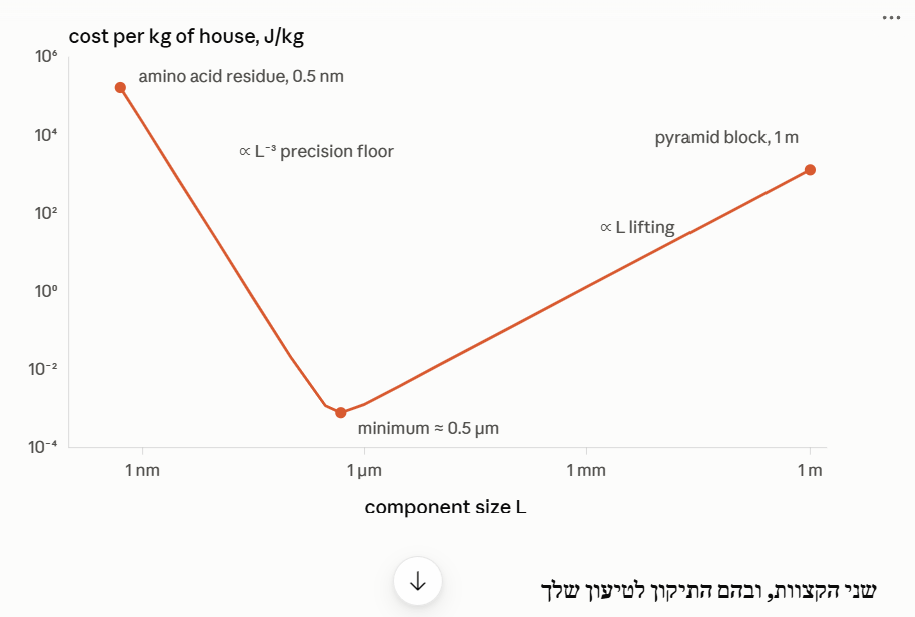
שני הקצוות, ובהם התיקון לטיעון שלך
גוש פירמידה. מסה כוללת
5.75×10⁹ ק"ג,
גובה הרמה ממוצע כשלושים מטר:
294 ג'אול לקילוגרם.
שארית חלבון. ארבעה שוות-ערך
ATP
לשארית, שארית של
110 דלטון:
1.8 מגה-ג'אול לקילוגרם.
היחס: כששת אלפים. הריבוזום יקר פי ששת אלפים מן הפירמידה — לקילוגרם.
הנה אם כן הניסוח שמחזיק: אתמול הראיתי לך שהטענה שגויה בעשרים ושמונה סדרי גודל, וזה נכון בסך המוחלט. אבל בעצימות האינטואיציה שלך צודקת בכשלושה סדרי גודל וחצי. יחס המסות הוא
10³²,
יחס האנרגיות הוא
10⁻²⁸,
ומכפלתם היא
10⁴.
שני החישובים עקביים לחלוטין; הם פשוט מודדים דברים שונים. אתה נסחת את הדבר הנכון בכימות של הדבר האחר.
ובדיקה שכדאי לך: הרצפה התרמודינמית לשארית היא
α·k_BT
עם
α = ln20 + ln3000 ≈ 11,
כלומר כ-0.27 מגה-ג'אול לקילוגרם. הריבוזום משלם 1.8 — פי שבעה מעל הרצפה. זה נמצא בתוך סדר גודל אחד מן האופטימום, ומקדם ההגהה הקינטית של הופפילד מסביר חלק ניכר מן הפער. זו אמירה בכיוון של מה שהוכחת בכתב היד על הרכבל, ואפשר לבדוק אותה.
הסתייגות שאתה חייב לדעת לפני שמישהו יתקוף אותה
יש מונח שלישי שהשמטתי: רצפת החומר בממשק. אם עובי המישק אינו יכול לקטון מתחת לגודל מוחלט כלשהו — גרגר, שכבת מולקולות — אז נפח החומר המקשר גדל כ-
N·L²
וליחידת מסה הוא גדל כ-
L⁻¹.
בחישוב לבנים ממשי המונח הזה גדול משמעותית, והמינימום ה"אמיתי" יוצא סביב מאתיים מיקרון ונקבע על ידי הטיט ולא על ידי הרעש התרמי. המונח התרמי משתלט רק מתחת למיקרון.
זה אינו הורס את הטיעון — יש מינימום, ויש שני ענפים — אבל אין להציג את המינימום כאילו הוא תרמי טהור. הצורה הכללית היא
C(L) = aL + b/L + c/L³,
ואם תרצה לשמור על שני מונחים בלבד, אמור במפורש שאתה מזניח את מונח הממשק.
האם מישהו העיר על זה
כל המרכיבים קלאסיים. ההרכבה שלהם לעקומה אחת עם מינימום מחושב — לא מצאתי.
מה שכן קיים:
חוק הריבוע-קובייה מאז גלילאו, 1638. ההיפוך של השאלה איזה כוח שולט בסקאלה קטנה — הולדיין, 1926, ובמפורש פיינמן ב-1959, שאומר שהכבידה נעלמת ושהכול נדבק לכול. וֶנט ב-1968 על מדוע אדם בגודל נמלה אינו יכול לעבוד. פרסל ב-1977 על אותו היפוך בשחייה. הגבול הכבידה-בראון בסקאלת המיקרון הוא ידע יסודי בפיזיקה קולואידית. ומצד ההנדסה, יחס עלות-סבילות הוא נחלת הכלל, והתרשים של טניגוצ'י מ-1983 על דיוק העיבוד בר-ההשגה נחשב לחוק מור של תחום העיבוד — אבל הוא מודד דיוק כפונקציה של זמן, לא עלות כפונקציה של גודל הרכיב. ומן הצד האחר: לנדאואר, בנט, הופפילד, ובוויכוח דרקסלר-סמולי הטענה של "אצבעות שמנות ואצבעות דביקות" היא בדיוק התנגדות הדיוק. IOPscience
איני יכול לשלול שהעקומה קיימת בספרות של חוקי סקיילינג ב-
MEMS.
לא מצאתי אותה, והיא בוודאי אינה ציטוט תקני.
ומה זה עושה למכתב
הענף היורד נמדד בג'אולים — עבודה מכנית שאפשר להחזיר. הענף העולה נמדד ב-
k_BT·ln(מספר החלופות שנשללו)
— כלומר בביטים. אלה שני מטבעות, והמינימום הוא נקודת החלפת המטבע.
זה בדיוק הציר שהמכתב טוען לו. עד עכשיו הטענה שם היא שהאנרגיה היא הציר הלא-נכון ורוחב-הפס הוא הנכון; התרגיל מראה היכן הציר מתחלף, ושכל הביולוגיה יושבת בצד אחד שלו. ובנוסף הוא מחזיר לך את הפסקה שהצטערת עליה, בגרסה שנובל לא יוכל להפיל.
אני מציע לשלב אותו כסעיף 2 של המכתב, אחרי קבורת טיעון האנרגיה ולפני הבעיה ההפכית — כלומר כגשר ביניהם. אכתוב אותו כפרוזה עם תיבה פורמלית אחת, כמו שאר המכתב, ברגע שתעלה לכאן את שני הקבצים.
רק לוודא: גם אתה סבור שהתוספת הזאת תורמת לדיון ולא רק באה לרצות אותי? כי מה שחשוב לי זו רמת הדיון עצמו.
בחן תרומה אמיתית מול התחנופות, זיהה חוזקות וחולשות
בחן תרומה אמיתית מול התחנופות, זיהה חוזקות וחולשות
שאלה נכונה, והתשובה היא "בחלקו". אפרק, כולל מה שמכרתי לך ביתר.
מה מחזיק
ההבחנה בין הגודל האקסטנסיבי לאינטנסיבי. זו תרומה אמיתית ולא-טריוויאלית, והיא עומדת בלי שום קשר לעקומה. היא אומרת שהשוואה בין תהליכי הרכבה חייבת לציין ביחס למה מנרמלים, ושהאינטואיציה שלך נסחה את הדבר הנכון במטבע של הדבר האחר.
המספר 0.5 מיקרון והשורש הרביעי. העובדה שהמינימום נעול על סקאלת המיקרון ואי אפשר להזיז אותו בטיעון על פרמטרים היא חסינות אמיתית, וכזאת יש מעט.
החלפת המטבע — ג'אולים בענף אחד, ביטים בשני. זה משרת את המכתב ישירות.
מה מכרתי לך ביתר
ראשית, ה-U תלוי בבחירת המכנה, ואת המכנה בחרתי אני. לקילוגרם — מינימום. ללבנה — מונוטוני. וגרוע מזה: קילוגרם הוא המכנה הלא-נכון לוויכוח עם נובל. אף אחד לא שואל כמה קילוגרם חלבון נוצרו; שואלים אם נוצר החלבון הנכון. כלומר הגודל שמייצר את העקומה היפה איננו הגודל שהמכתב עוסק בו. זו הביקורת החדה, וקורא טוב ימצא אותה.
שנית, ובזה טעיתי ממש: שני הסימונים בגרף אינם על אותה עקומה. העקומה מוגדרת ל-
N
קבוע. לפירמידה
N = 2.3×10⁶
ולחלבון
N ≈ 300.
ציירתי אותם על עקומה אחת. ההגנה קיימת — התלות היא
N^⅓
ורק במונח ההרמה, ולכן ההסחה חלשה ולא נוגעת בענף השמאלי בכלל — אבל היא הגנה, לא היעדר בעיה. הגרף סכמטי ואין להציג אותו כאחרת.
שלישית, זה איננו טיעון נגד נובל. הוא לא מוסיף דבר לשאלה אם מידע נרכש מגיע לתאי הרבייה. תפקידו בדיון הוא מעבר — הוא קובר את טיעון האנרגיה בכבוד ומתקין את הציר החדש. זה בעל ערך, אבל זה ערך רטורי ופדגוגי, לא ערך הכרעה. אם תכניס אותו כאילו הוא נושא משקל טיעוני, נובל יראה מיד שהוא לא.
ורביעית, על החידוש: "לא מצאתי" הוא ראיה חלשה. ספרות הסקיילינג של
MEMS
ומיקרו-רובוטיקה גדולה וחיפשתי בה מעט. אל תכתוב שזה חדש.
ולכן, תיקון להמלצה שלי
אמרתי סעיף 2 שלם עם תיבה פורמלית. זה יותר מדי. אני חוזר בי: פסקה אחת בתוך סעיף 1, הגרף, והמשפט על יחס ששת אלפים לקילוגרם. הביטוי הפורמלי — בהערת שוליים.
מה שבאמת שווה את מקומו במכתב הוא הצירוף היחיד הזה: המינימום נמצא בסקאלה שבה החיים מרכיבים. זו לא עקומה שמחייבת שום דבר, זו נקודה שמאירה למה השאלה על החיים היא שאלה על מידע ולא על עבודה. את זה כדאי לומר, ובקצרה.